
Why Good Research Still Earns Weak Coursework Marks (and How to Fix It)
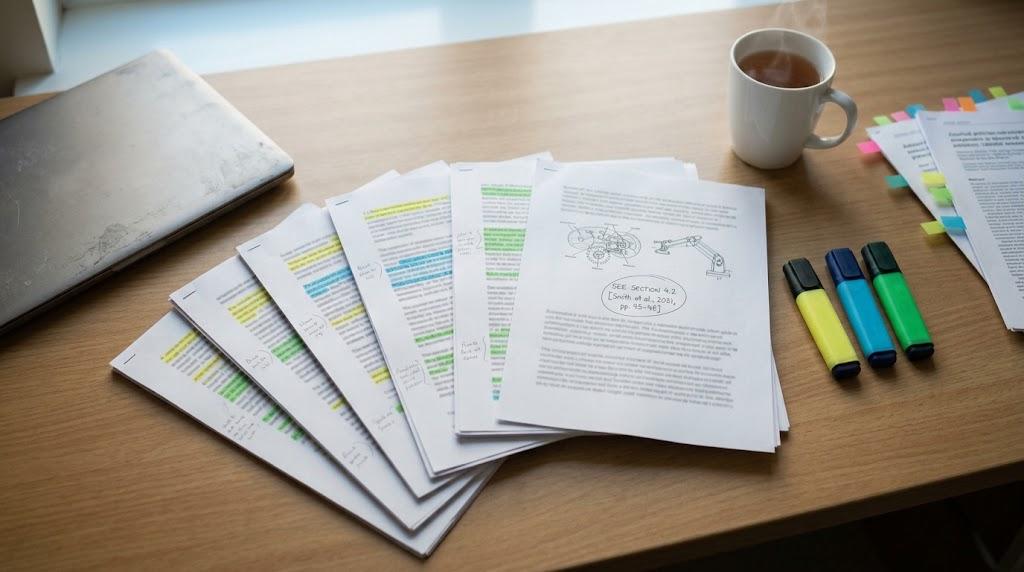
Hours in the library. Pages of notes. A reference list that looks the part. Then the feedback arrives: “too descriptive” or “needs more critical analysis.”
It stings, because the effort was real. But effort is rarely the problem.
The gap usually sits between finding a good source and using it to answer the question. The facts are there. The thinking that connects them isn’t.
That’s good news. A gap in explanation is far quicker to fix than a gap in knowledge.
Knowing a topic isn’t the same as arguing it
Imagine a question asking whether financial rewards improve employee motivation. You gather articles on pay, satisfaction, retention and productivity. You summarise each one and cite it correctly.
It looks thorough. Yet the question is still unanswered: what do these findings actually say about motivation?
Higher pay might ease money worries without making anyone enjoy their job more. Recognition may lift one person and leave another cold. Until you work through those differences, you’re reporting information, not using it.
The balance between explanation and evaluation shifts as you progress. At Level 4, work often focuses on an accurate grasp of core concepts, though analysis can still be expected. At Levels 5 and 6, you’re commonly asked to compare perspectives, assess evidence and build independent arguments. A-Level and BTEC work also needs explanation and application, with expectations set by the unit and assessment criteria.
You aren’t marked on how much you’ve read. You’re marked on what you can reasonably conclude from it.
Five problems that quietly cost marks
Guidance is only useful when it fits your actual brief. Whether it comes from a tutor, a study guide or a Coursework writing service, generic advice that could suit any assignment won’t fix this one. Start with the problems below.
1. Describing a theory without testing it. A paragraph can explain a leadership model perfectly and never ask whether it fits the situation in the question.
2. Claiming more than the evidence shows. A study finds remote workers report higher job satisfaction. Claiming that remote working raises productivity goes a step too far.
3. Ignoring where the research took place. A study in a large tech firm may not transfer to a small care home with different pressures. The source stays useful; its relevance needs weighing.
4. Drifting away from the question. A short note on a theory becomes three paragraphs of history, and the assignment wanders off.
5. Paragraphs that don’t talk to each other. Each holds good material, but the argument never builds. It reads like research notes.
A simple check that exposes weak reasoning
Try the three-colour check on a paragraph you’re unhappy with. Highlight the main claims in yellow, the evidence in blue, and the sentences explaining what the evidence means in green.
The colours aren’t a marking scheme, and not every sentence will fit neatly. The point is to spot where the reasoning disappears. Plenty of yellow and blue but almost no green? You’ve probably found your descriptive paragraph.
Then take one blue section and ask: what does this evidence establish, and what does it leave uncertain? Write the answer in your own words and connect it back to the question. That often does more than adding another reference.
Treat it as a diagnostic, not a formula. Markers also tend to skim opening sentences first, so make yours count.
Three skills that bring it together
Critical thinking means examining a claim before deciding how far to trust it: its assumptions, the alternative explanations, and whether the evidence carries the conclusion. It doesn’t mean finding fault with every source.
Evaluation judges the value and limits of an idea. A study may offer useful evidence on motivation yet say little about whether the findings hold in another industry. That limit affects how confidently you can apply it.
Synthesis brings evidence together instead of treating each source alone. If two studies disagree about remote working, ask whether they studied different occupations, measured productivity differently or looked at different working arrangements.
Used together, they’re powerful. Critical thinking questions the findings, synthesis compares the explanations, and evaluation judges which conclusions are best supported. Your argument then returns that judgement to the question.
Revising a weak paragraph
Restate the question in your own words and spot the task word. Analyse looks at causes or relationships, compare at similarities and differences, and evaluate calls for a reasoned judgement.
Then ask: what am I claiming, what supports it, and why does it matter to the question? The third usually exposes the weakness.
Before: “Maslow’s hierarchy of needs explains that people have different levels of needs. Financial rewards can satisfy basic needs, while recognition may support higher-level needs. The theory is used to explain employee motivation.”
It only reports the theory.
After: “Maslow’s hierarchy offers a way to consider how financial security and recognition may influence motivation. However, employees don’t necessarily rank these needs in the same order. Someone facing financial uncertainty may value pay, while another may care more about autonomy. The model helps frame the discussion, but applying it needs attention to individual circumstances and evidence.”
The revision judges the theory and names a limit. In real coursework, add citations.
Mistakes worth avoiding
Adding references to rescue a weak argument. If your sources already support the point, you’re missing explanation.
Treating “critical” as “negative”. Credit strengths as well as limits.
Confusing correlation with cause. Satisfaction and productivity may move together without either driving the other.
The takeaway
If your coursework scores lower than expected, resist starting again or finding twice as many sources. Return to your paragraphs and look for where you stop explaining, where a claim outruns the research, or where a detail pulls you off the question.
A few revised paragraphs can do more than pages of new material. If evidence is genuinely missing, research more. If it’s there, explain it.
For your next session, pick one paragraph and trace it from claim to evidence and back to the question. If that journey is hard to follow, supply the missing explanation.
The aim isn’t longer paragraphs. It’s points that are easier to understand, harder to misread and clearly backed by the evidence.

 English
 Arabic
 French
 Spanish
 Portuguese
 Deutsch
 Turkish
 Dutch
 Italiano
 Russian
 Romaian
 Greek