
Interlining Performance Guide — Interlining-Factory’s Approach To Durable Design
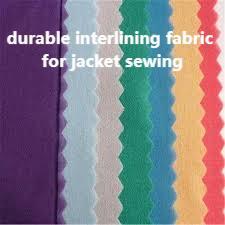
In every thoughtfully made garment there is an often-overlooked component whose presence quietly determines fit and function — the Interlining that sits between shell and lining provides structure without announcing itself, and the correct selection of Interlining can be the difference between a garment that endures and one that disappoints. Understanding this hidden layer helps designers, pattern makers, and manufacturers make choices that improve silhouette, comfort, and longevity.
Understanding the role of internal support
The internal layer’s main job is to support shape and stabilize fabric behavior. It controls how collars hold, how lapels sit, and how seams react to movement and laundering. Instead of relying on visible construction alone, smart use of internal support can create the visual crispness of tailored pieces while maintaining wearer comfort.
Materials and construction methods
Producers choose from heat-activated adhesives or sew-in options, and from woven to non-woven constructions. Lightweight, non-woven supports are often used with delicate fabrics to preserve drape, while woven supports more closely mimic the hand of tailored cloth and are preferred in structured garments. The application technique — whether applied by fusing or stitching — also impacts bulk and flexibility.
Balancing performance with comfort
A successful internal layer enhances durability without sacrificing breathability. Advances in low-temperature adhesives and open-structure supports allow stabilization while minimizing stiffness. Additionally, selecting materials that resist discoloration and maintain dimensional stability through repeated wash cycles reduces customer complaints and returns.
Sustainability in hidden layers
Sustainable choices are no longer optional. Recycled fibers, reduced-energy bonding processes, and materials designed for easier recycling at end-of-life are gaining traction. Manufacturers are testing blends that achieve necessary mechanical properties while lowering environmental impact, and designers are increasingly requesting documentation of recycled content and environmental certifications.
Design integration and pattern-level thinking
Internal support should be part of the concept stage, not an afterthought. Mapping where support is needed on each pattern panel prevents overuse in areas that add unnecessary weight, and ensures critical zones — collars, facings, waistlines — receive the right reinforcement. This panel-level approach reduces prototyping iterations and yields more predictable outcomes in production.
Testing and quality assurance
Compatibility testing between face fabric and internal layer is essential. Small-scale bonding tests, wash and wear simulations, and seam stress trials reveal how the assembly behaves in real conditions. Documenting test results and building a reference matrix for different fabric weights and fiber types speeds specification and reduces mistakes during ramp-up.
Applications across categories
Casual tops benefit from minimal internal support that maintains necklines without restricting stretch, while formal wear often requires heavier internal shaping to achieve lasting form. Technical garments — such as performance outerwear — use low-bulk supports to stabilize attachments and zippers without trapping heat or moisture.
Practical tips for teams
Begin with clear communication between designer, pattern maker, and technician. Specify desired aesthetic outcomes and functional needs (e.g., crisp lapel, soft neckline) early. Request compatibility samples and insist on realistic laundering tests. Keep a concise library of proven pairings for commonly used fabrics to reduce development time.
Future directions and innovation
Expect further advances in adhesives that bond reliably at lower temperatures and in engineered fiber webs that mimic traditional properties with lighter weight. Digital tools that store panel-level specifications and suggested internal supports will help scale best practices across production lots, reducing variability and improving first-pass yield.
Final thoughts and resources
The invisible layer inside a garment is a major determinant of perceived quality and performance. Thoughtful selection and placement of internal supports deliver better-fitting, longer-lasting clothing that meets both designer intent and wearer expectations. For a practical, detailed guide on types, applications, and selection strategies, visit https://www.interlining-factory.com/news/what-is-interlining-types-applications-and-more.html

 English
 Arabic
 French
 Spanish
 Portuguese
 Deutsch
 Turkish
 Dutch
Dutch
 Italiano
 Russian
 Portuguese (Brazil)
 Greek
Greek